

Bridges are an essential part of a city’s infrastructure, writes vancouver-future. They significantly simplify traffic flow and, at times, allow for quick transit between opposite sides of a city. This is not only convenient for drivers but also helps connect the city’s most remote areas with those closer to the centre.
Moreover, bridges play a crucial role in managing traffic distribution. Some cities have bridges designated exclusively for truck traffic, with clear separation of lanes for passenger vehicles and heavy transport.
Speaking of Vancouver, it is worth noting that the city boasts numerous bridges, each with a unique history. Many of these structures were built in the 18th century, later improved and modernized. These restorations add to their charm, offering a glimpse into the city’s development. Local museums often preserve photographs and illustrations of historic bridges, providing a visual chronology of these architectural marvels.
Bridges are frequently associated with fascinating historical events. They are often named after notable figures who have some connection to their construction.
Thus, bridges deserve to be the subjects of books, articles, and essays as they stand as witnesses to history.
Continuing our series on Vancouver’s bridges, we cannot overlook one of the city’s oldest structures. With references to vancouver.ca, we’ll explore the Cambie Street Bridge and its many interesting facts and events. This historical site is valuable and significant for Vancouver.
So, settle in and join us in diving into the history of this ancient and remarkable bridge.
Overview
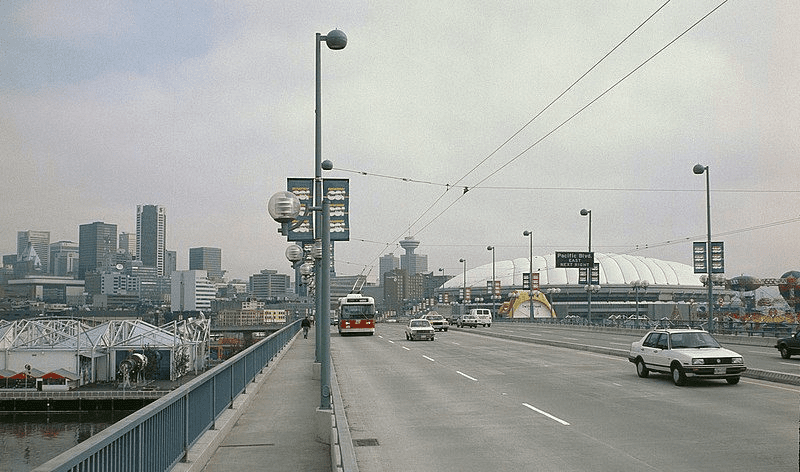
The Cambie Street Bridge is a concrete road bridge with a girder design that spans Vancouver’s well-known False Creek.
The current structure, built in 1985, is the third bridge on this site.
The bridge connects False Creek’s southern shore to two central streets, Nelson and Smithe. It is the easternmost bridge in the area, with the Burrard and Granville bridges located farther west.
The Old Bridge
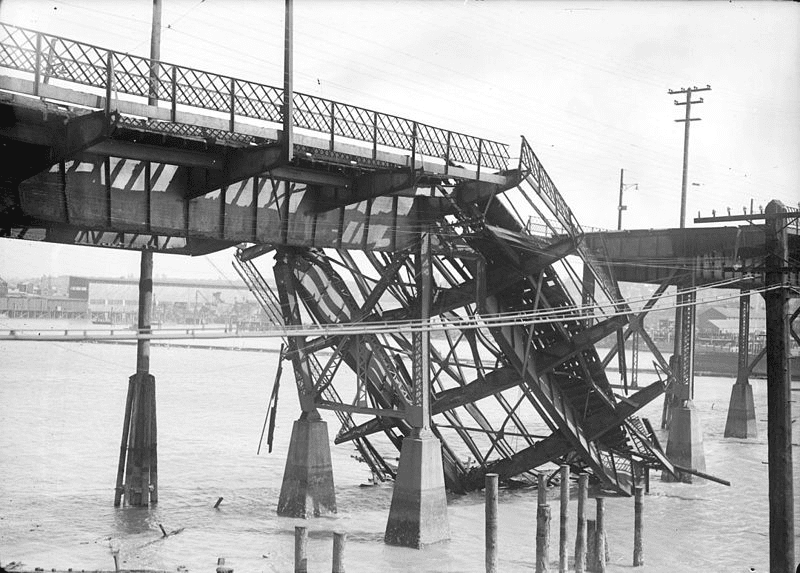
The first Cambie Street Bridge opened in 1891. It was a simple trestle structure made of wooden piles, featuring a swing span in the middle. The project cost $12,000 CAD.
The Second Version
The government later decided to replace the original bridge. The second iteration was a four-lane steel bridge spanning 1,247 metres.
One significant innovation was the inclusion of a tram system.
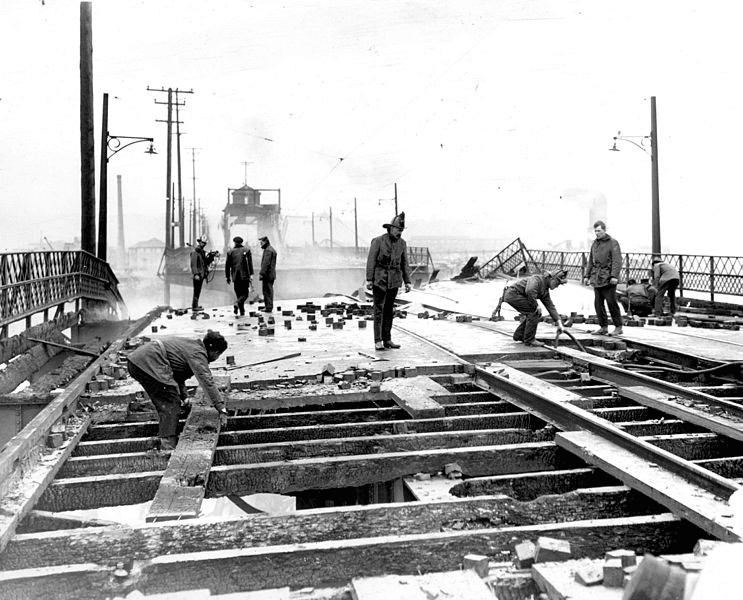
Completed in 1911, the construction cost $740,000 CAD. The new bridge was inaugurated on May 24, 1911.
Distinguished Guests
In 1912, Canada’s Governor General Prince Arthur, Duke of Connaught and Strathearn, along with the Duchess and their daughter Princess Patricia, visited Vancouver and presided over a ceremony renaming the bridge the “Connaught Bridge.”
However, the new name failed to gain popularity, and locals continued calling it the “Cambie Bridge,” honouring Henry John Cambie, a pioneer and Vancouver native.
Accidents
The swing span of the bridge was a steel, through-truss design, requiring a four-hour advance notice for opening.
In 1953, the swing span was opened 79 times. Eventually, its use was reduced to twice a week.
The swing span caused many traffic accidents, as its structure separated the bridge’s inner lanes from the outer ones.
On one occasion, the wooden deck—treated with creosote—caught fire, leading to the collapse of a steel side span measuring nearly 24.5 metres.
A Successor Bridge
Between 1983 and 1985, a new, higher, non-swing bridge was constructed as the successor to the 1911 version.
To facilitate construction, the crossing was closed for nine months starting in November 1984. The project involved integrating a newly built concrete bridge with existing approaches.
The new bridge cost nearly $53 million CAD and opened on December 8, 1985. Construction proceeded rapidly to prepare the bridge for the Expo 86 event.
The New Bridge
The 1985 bridge is a continuous span structure made of prestressed concrete girders. It measures 1,100 metres in length, features six traffic lanes, and includes pedestrian pathways.
The addition of volcanic ash during the paving process resulted in the bridge’s unique concrete tint.
The Heating Plant
The bridge’s southern end houses the Neighbourhood Energy Utility, a heating plant owned by Vancouver. It supplies heat and hot water to all buildings in Southeast False Creek.
Research Findings
Both sides of the bridge are equipped with pedestrian sidewalks, separated from vehicle traffic by concrete barriers.
The Cambie Street Bridge is the second most-used bridge by pedestrians in the False Creek area.
A 2002 study revealed that over 1,500 people crossed the bridge daily on foot. Cyclists frequently use the bridge’s wide sidewalks as well.
Cyclists are also permitted to ride on the road, with access available in both directions.
A Venue for Running
The Cambie Street Bridge is frequently used as a running route for various sporting events. Notably, it serves as part of the course for the Vancouver Sun Run and the Vancouver Marathon.
The End of the “Car Era”
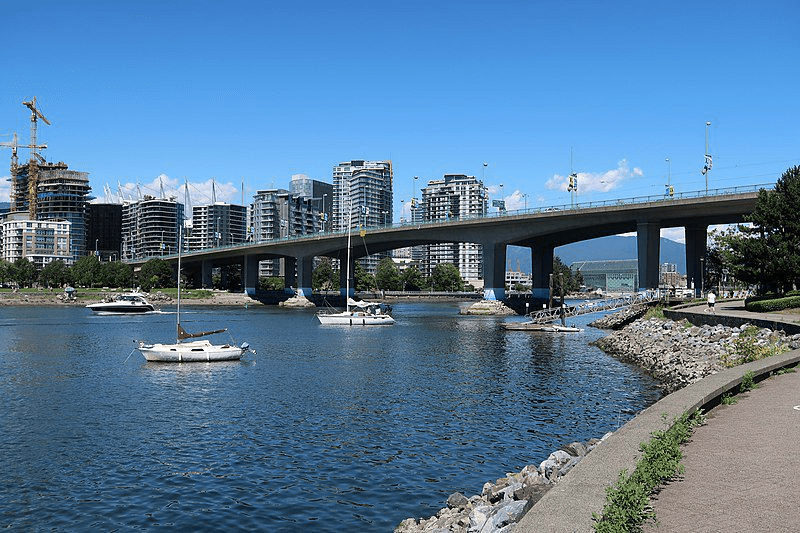
TransLink bus routes, including Routes 15 and 17, also use the Cambie Street Bridge.
On January 17, 2018, Vancouver authorities decided to convert one of the bridge’s vehicle lanes into a dedicated bike lane. This decision was driven by a decrease in car traffic on the bridge over the past 20 years, while bicycles accounted for approximately 80,000 daily crossings.
The official construction of the bike lane began on June 2, 2018, and it opened to the public on June 25 of the same year.
A New Role
In the summer of 2021, the Cambie Street Bridge was chosen as the site for the Voxel Bridge project, a showcase of augmented reality as part of the Vancouver Biennale initiative.