

The Vancouver Airport is one of the most popular in North America. Learn about how the “air gateway” was established, its development over the years, and why it can be considered a masterpiece in our article on vancouver-future.
History
The idea of establishing an airport emerged in 1927, inspired by aviator Charles Lindbergh. He excluded Vancouver from his tour from New York to Paris due to the lack of a suitable landing field.
The airport’s history began in 1929, when the city decided to purchase land on Sea Island. Two years later, the airport officially opened.
At the time, it featured a wooden administrative building with the unique architecture of British Columbia, a couple of hangars, and a single small but solid runway. No other airport in Canada could boast such a masterpiece at the time.
During World War II, the airfield was used as a military training base, leading to its expansion.
After the war, the airport was returned to the city and resumed commercial flights.
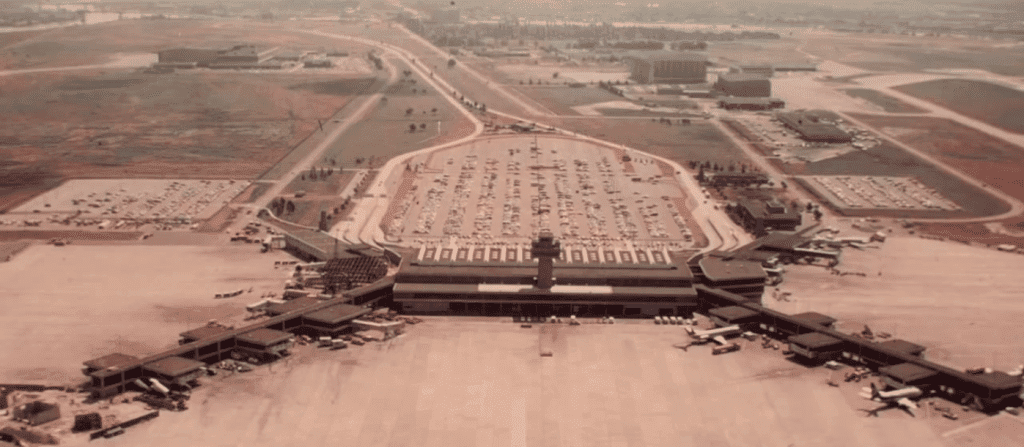
In the early 1950s, Vancouver’s “air gateway” continued to grow, with the addition of a new runway and the opening of a new terminal. This terminal served both passenger and military purposes, with new parcels of land allocated for its construction. The airport also became Canada’s first jet aircraft hangar. During this period, numerous new routes were introduced, including transatlantic flights to Europe.
As Vancouver continued to grow, the city needed a larger terminal.
The Main Terminal
The main terminal was completed in 1968, allowing the airport to accommodate larger aircraft such as the Boeing 747. The first Boeing aircraft landed on Vancouver’s runway three years after the terminal’s opening.
The airport continued to evolve, aided by the construction of the Arthur Laing Bridge and the Expo 86 World’s Fair. These developments prompted modernization to handle the influx of visitors.
In 1994, plans were made to build a new terminal on the site of one of the older airport facilities. Opened two years later, this terminal featured 16 boarding gates and cost $250 million.
The 21st Century
In 2001, during the 9/11 terrorist attacks, a large number of flights were redirected to Vancouver. For its successful handling of this unprecedented situation, the airport received an award from the British Columbia Aviation Council.
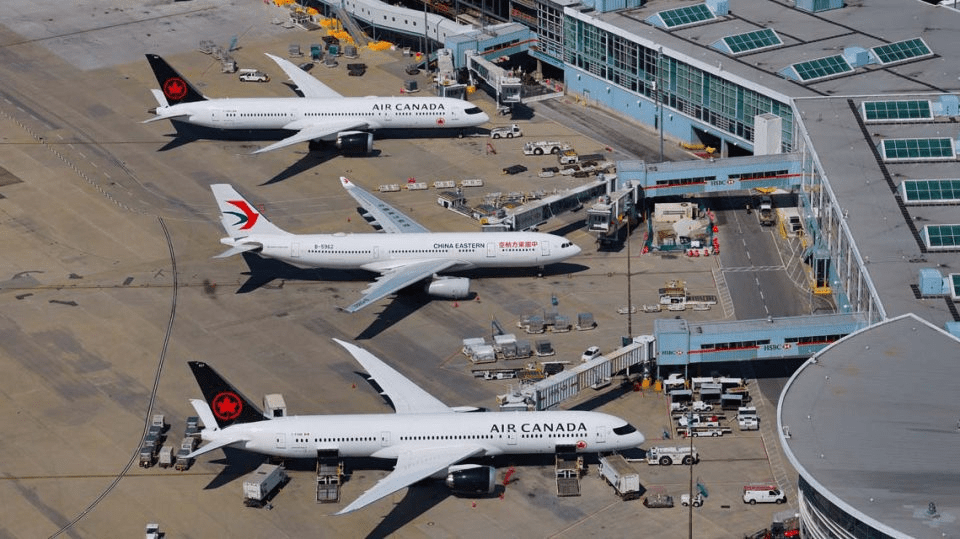
In 2010, ahead of the Olympic Games, a subway line was constructed to connect the airport, making transportation easier for athletes and coaches. Following the Olympics, Vancouver Airport began actively expanding routes to Asia, particularly China. In 2016, it was awarded the title of “World’s Best Airport.”
Airport Interior and Destinations
The airport features a chapel, yoga spaces, and even a pet relief area.
Upon arrival, passengers are greeted by a stunning waterfall and a captivating blue-green colour scheme symbolizing the harmony of the sky, nature, and ocean. Additionally, the airport houses approximately 40 restaurants and numerous coffee shops.
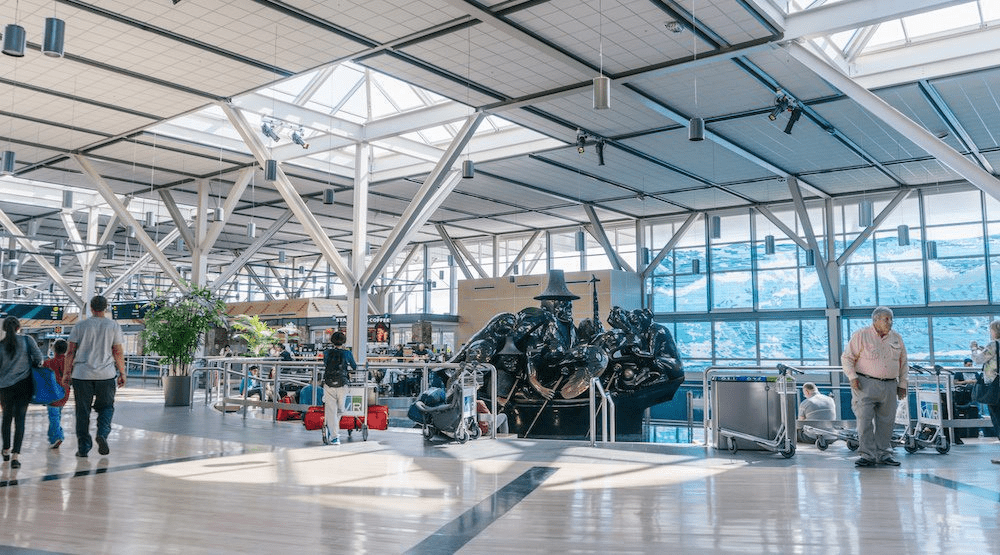
The airport consists of a main International Terminal, a Domestic Terminal, and a South Terminal, the latter serving small aircraft and seaplanes.
From these state-of-the-art terminals, passengers can fly to many countries worldwide. As previously mentioned, one of the airport’s priorities is developing transit routes to China. Numerous flights also connect to cities across North America. In Europe, flights are available to Frankfurt, Munich, Amsterdam, London, and Istanbul.
According to 2019 statistics, the airport served 26 million passengers. By 2037, the projected passenger traffic is expected to grow to 35 million people.