

BC Ferries is the company that provides passenger and cargo transportation services for the coastal and island communities of British Columbia. It was established in response to service issues caused by labour disputes within the Black Ball Line and Canadian Pacific Railway. Today, BC Ferries is the largest ferry company in North America, operating a fleet of 41 vessels and serving over 47 locations along the British Columbia coastline. Read more on vancouver-future.
The company provides vital connections between the provincial mainland, the coastal islands, and remote areas without road access. Funding and support from the federal and provincial governments allow the company to maintain a high level of service on these critically important routes. Meanwhile, inland ferries on the region’s rivers and lakes are managed by private companies under contract with the British Columbia Ministry of Transportation and Infrastructure.
Founding and Development of BC Ferries
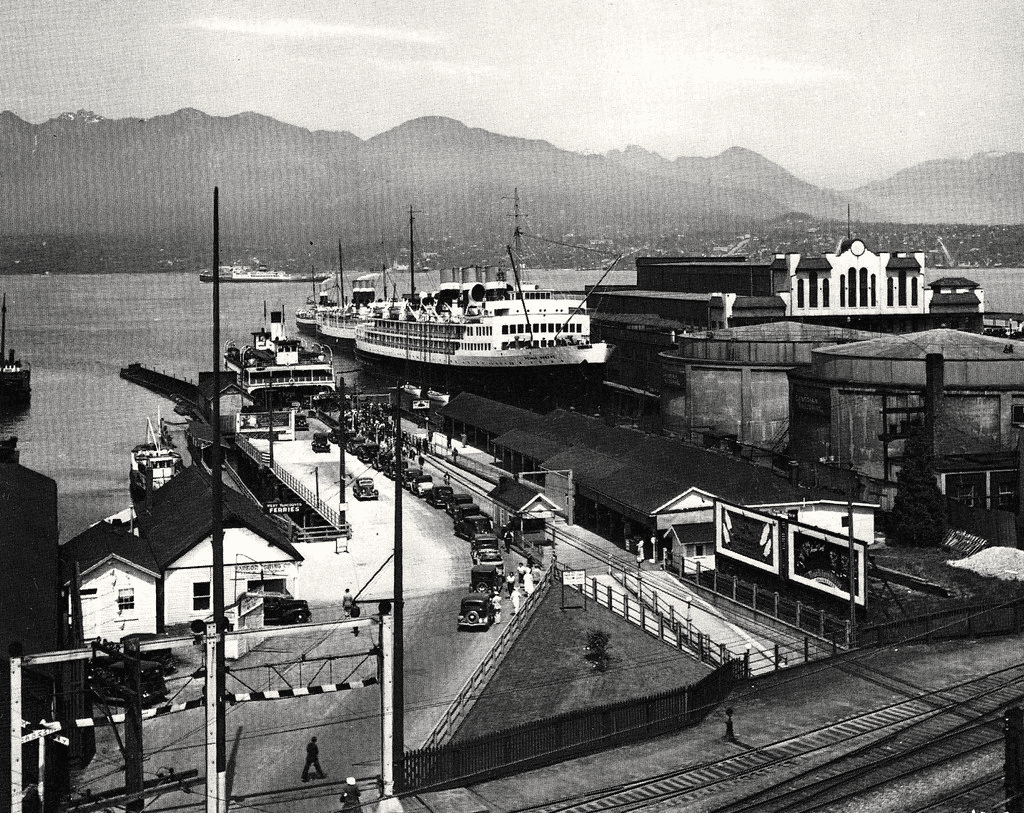
BC Ferries was founded in 1960 to ensure reliable ferry service between Vancouver and Vancouver Island following a series of strikes by CP Steamships and Black Ball Line employees, which disrupted regular passenger transport. The Government of British Columbia, led by Premier W.A.C. Bennett, decided that coastal ferries should be publicly owned and established a new corporation. Transportation Minister Phil Gaglardi was appointed to organize it.
The first BC Ferries route opened in 1960 between Swartz Bay on Vancouver Island and Tsawwassen on the mainland. Two vessels, the MV Tsawwassen and the MV Sidney, were used for this service. Immediately following this, BC Ferries began expanding its route network, absorbing other private companies, including the Black Ball Line. As a result, the company actively increased its fleet size to meet growing demand. One of the innovative solutions was the “stretching and raising” program for ferries, which allowed their capacity to be expanded without the need for new construction. This involved cutting older vessels in half, lengthening them, and then raising the vehicle deck to increase passenger and cargo capacity.
In general, most BC Ferries vessels were built in British Columbia, which contributed to the development of the local economy and created jobs in the shipbuilding industry. Only a few ships were purchased abroad due to the limited capacity of local enterprises. In the mid-1980s, the company also took over the operations of the BC Ministry of Transportation, which served smaller coastal communities. This significantly expanded the route network and increased the number of passengers carried. BC Ferries also became known for its signature flag featuring a “dogwood flower” on a green background, which was used until 2003. This flag became a symbol of reliability and quality service, raising the company’s recognition among locals and tourists.
Financial Challenges and BC Ferries Reorganization
In 2003, BC Ferries faced financial difficulties that led to the company’s reorganization. The adoption of the Coastal Ferry Act allowed the company to be privatized while maintaining control by the Provincial Ferry Authority, which holds the single voting share. Today, BC Ferries is one of the largest ferry companies in North America, serving over 40 locations on the British Columbia coast. The company continues to play a key role in transportation infrastructure, providing regular connections between coastal communities, islands, and the provincial mainland. As such, BC Ferries remains a vital element of Vancouver’s economic and social development.
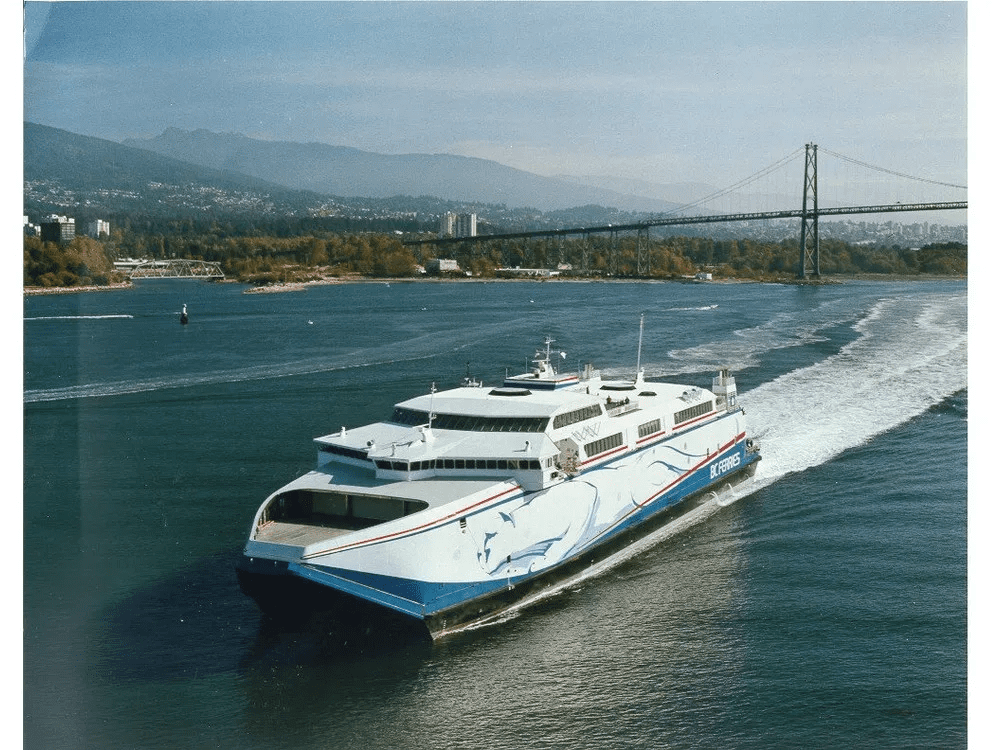
In the 1990s, the NDP government ordered the construction of three fast ferries to improve service between the mainland and Vancouver Island. However, these vessels became problematic due to numerous technical issues and significantly exceeded initial costs (double what was planned). In 2003, the fast ferries were sold for $19.4 million. In July 2004, a controversy arose when BC Ferries, under the leadership of a new American CEO, announced that it had rejected all Canadian bids for the construction of three new Coastal-class vessels, considering only European options. The overall contract for the construction of the vessels was valued at $542 million. Each ferry was designed to accommodate 370 cars and 1,600 passengers.
The argument for supporting domestic ferry construction was that it would provide jobs for many Vancouver residents, help revitalize the local shipbuilding industry, and bring additional tax revenue to the provincial budget. However, BC Ferries CEO David Hahn stated that building the ferries in Germany would save nearly $80 million and potentially lower fares for passengers.
New Vessel Construction and BC Ferries Cost Reductions
On September 17, 2004, BC Ferries awarded a contract to the German shipyard Flensburger for the construction of three vessels. The contract stipulated a fixed price and a rigid schedule, helping to avoid delays in ship delivery. The first of the ferries, Coastal Renaissance, entered service in March 2008; Coastal Inspiration was delivered the same month and began passenger service in June of that year. The third ferry, Coastal Celebration, was also delivered in June. On August 18, 2006, BC Ferries ordered the construction of a new vessel for the Inside Passage route from the same German shipyard, Flensburger. The contract for its creation had similar terms to the previous one (for the Coastal-class vessels).
On August 26, 2012, BC Ferries announced a reduction of 98 sailings on its major routes, scheduled to begin in the fall and winter of 2012. This was part of a four-year plan to save $1 million. The cancellations included the removal of additional sailings on the Swartz Bay–Tsawwassen route, 18 sailings on Horseshoe Bay–Departure Bay, and 48 sailings on Duke Point–Tsawwassen.
Fleet Modernization and BC Ferries Standardization
Free ferry travel for seniors was suspended from April 2014 to April 2018. In 2014, BC Ferries announced plans to add three new Intermediate-class vessels to replace the Queen of Burnaby and Queen of Nanaimo. These new ships were named Salish Orca, Salish Eagle, and Salish Raven, becoming part of the new Salish class of ferries. A fourth ship, Salish Heron, was added in 2022. All four vessels were designed and built in Poland at the Remontowa Shipbuilding S.A. shipyard and equipped with dual-fuel engines that allow them to run on both liquefied natural gas (LNG) and marine diesel.
These ferries are part of BC Ferries’ fleet standardization plan, which aims to reduce the number of vessel classes from 17 to 5. The new replacement classes will include Northern, Major, Salish, Shuttle, and Island. However, BC Ferries noted that full fleet standardization will not be achieved for another 40 years. As of March 2024, the fleet consists of 11 classes of vessels, as well as 8 unique (non-classed) ferries.